Wednesday, August 26, 2026

A Directory to this Site

Turpin Tree is a place to share information related to the genealogy and history of the Turpins and allied families. You are invited to submit relevant items via email, or you may post "comments" below.


New:

Books


:::

Others

Video Tours

The Mary Draper Ingles Connection: How a Turpin Ancestor's Household Ties Back to One of Virginia's Most Famous Frontier Stories

Statue of Mary Draper Ingles


By J. Randolph Turpin, Jr., D.Min.


Bottom line: Our ancestor Martin Turpin came under the roof of a family connected by marriage to Mary Draper Ingles, one of the most famous survivors of the American frontier.

In the course of research aimed at establishing the documented facts of my ancestor Martin Turpin's life, I found an unexpected connection to a woman whose pain and courage earned her a place in the pages of American history. I discovered that the family who took young Martin in, under Virginia's poor laws in 1797, was itself bound by marriage to one of the most famous survival stories of the American frontier—the story of Mary Draper Ingles (1732–1815). This article lays out the evidence.

Who was Martin Turpin, and why does this matter to his story?

Martin Turpin (b. 1783) is my fourth great-grandfather. At fourteen, with no parent able to support him in Montgomery County, Virginia, he was bound under the county's poor laws to a local landowner named David Love (1763–1827). Martin later made his way to Knox County and then Anderson County, Tennessee, where he married, farmed, and raised a family. David Love's wife, it turns out, connects that household to a story far larger than either man—which is what this article is about.

Who was Mary Draper Ingles?

On July 30, 1755, a band of Shawnee warriors raided the small frontier settlement of Draper's Meadow, near present-day Blacksburg, Virginia, killing several settlers and taking five captive—among them twenty-three-year-old Mary Draper Ingles, her two young sons, and her sister-in-law, Bettie Robertson Draper (the wife of Mary's brother, John Draper). The captives were marched roughly five hundred miles to a Shawnee town in present-day Ohio. That fall, Mary escaped and walked her way home through the wilderness—a journey of several hundred miles that took over a month and has since become one of the most famous survival stories of the colonial frontier, retold in books, film, and an outdoor drama still performed each summer in Radford, Virginia. See the television movie, Follow the River, for a representation of the story.

Mary Draper Ingles's story is not, on its own, part of my family's history. But Mary’s niece did play a role in the Turpin family saga. Her brother's (John Draper's) daughter married into the very household my own ancestor depended on and lived with, first in Virginia and eventually in Tennessee.

Who was John Draper?

John Draper, born about 1730 in Virginia, was Mary Draper Ingles's brother.[^1] He married Elizabeth "Betty" Robertson in April 1754—the same Betty Robertson who was captured alongside Mary in the 1755 raid.^2 He lived at Drapers Meadow, in what was successively Fincastle and then Montgomery County, and he served as a captain in the Fincastle and Montgomery County militias—notably under the command of his own brother-in-law, Colonel William Ingles, Mary's husband.^3 Betty died in 1774; John lived on, remarried, and died in Wythe County, Virginia, in 1824.^4

This is a documented man, not a name recovered from tradition alone. His military service, his residence, and his family are all recorded. 

Who was Mary Draper Love—and why does she matter to the Turpins?

John Draper’s daughter, Mary Draper, married David Love, in July of 1784, in Montgomery County, Virginia.[^5] David Love was a landowner and mill operator on Neck Creek in the same county. It was David Love to whom my ancestor Martin Turpin was bound as a poor-law apprentice in 1797.[^6] The Loves later moved to Maury County, Tennessee, where both David and Mary are buried at Wilkes Cemetery in Culleoka.[^7] 

None of that, by itself, connects Mary Draper Love to Mary Draper Ingles. A shared name alone is not conclusive evidence of a shared family. What follows is the evidence that closes that gap.

The evidence

Three independent sources establish that Mary Draper Love was the daughter of this specific John Draper—Mary Draper Ingles's brother.

First, the marriage bond itself. The bond executed for David Love's marriage states plainly that he "hath obtained Licence for his Marriage with Mary Draper daughter of John Draper."[^8] This is about as close to a primary source as this kind of question ever gets—a legal document executed at the time of the marriage, naming the bride's father directly.

Second, a published genealogical source. Marise Parrish Lightfoot's history of Maury County's Revolutionary War veterans records David Love's marriage "to Mary Draper, daughter of Capt. John Draper of Draper's Valley."[^9]

Third, and most decisively, a reviewed genealogical record. The Daughters of the American Revolution's Ancestor Database carries a record for John Draper (Ancestor #A033550) that matches every particular already established independently: born 1730, Virginia; residences at Drapers Meadow in Fincastle and Montgomery Counties; rank of Captain; service under "Col. William Ingles"; first wife Elizabeth Robertson, married April 1754.[^10] The lineage statement associated with this record names Mary Draper as the child of this John Draper and Elizabeth Robertson. I confirmed directly that this specific lineage entry carries no error flag; DAR does flag known problems elsewhere in a patriot's record when they exist, and this entry is clean.[^11]

A physical marker corroborates all of this on the ground. At Wilkes Cemetery in Culleoka, Tennessee, a plaque affixed to Mary Draper Love's own headstone identifies her as "daughter of Revolutionary soldier John Draper"—placed there in 2004 by the Samuel Hammond and Tennessee chapters of the DAR.[^12]

What this means

Let’s be precise about what has and has not been established. What is documented: Mary Draper, who married David Love, was the daughter of a specific, well-documented John Draper of Drapers Meadow—the same John Draper who was Mary Draper Ingles's brother. That makes Mary Draper Love the niece of Mary Draper Ingles, and it means that when my ancestor Martin Turpin was placed in David Love's household in 1797, he came under the roof of a woman who had grown up in the shadow of one of the most remarkable survival stories in Virginia's frontier history.

I do not know whether that association with such an extraordinary adventure meant anything to Martin himself. That's not something the record can tell us. But the family relationship itself is not just a hoped-for connection. It's documented.


Notes:

[^1]: National Society Daughters of the American Revolution, "Draper, John," Ancestor #A033550, DAR Genealogical Research System, Ancestor Database, accessed August 13, 2026.

[^2]: Ibid.

[^3]: Ibid.

[^4]: Ibid.

[^5]: David Love and Mary Draper, Marriage Bond, "Montgomery, Virginia, United States records," images, FamilySearch, image 222 of 854, Image Group Number 007740792.

[^6]: Virginia, County Court (Montgomery County), Order Book 10, 1797–1798, image 29 of 143, entry for May 2, 1797, "Montgomery, Virginia, United States Records," digital images, FamilySearch, accessed August 12, 2026.

[^7]: Find a Grave, memorial records for David Love (1763–1827) and Mary Draper Love (1768–1840), Wilkes Cemetery, Culleoka, Maury County, Tennessee.

[^8]: David Love and Mary Draper, Marriage Bond, cited above.

[^9]: Marise Parrish Lightfoot, Let the Drums Roll: Veterans and Patriots of the Revolutionary War Who Settled in Maury County, Tennessee (Maury County Historical Society, Bicentennial publication).

[^10]: National Society Daughters of the American Revolution, "Draper, John," Ancestor #A033550, cited above.

[^11]: Author's direct examination of the DAR Ancestor Database record, August 13, 2026.

[^12]: Author's personal visit to Wilkes Cemetery, Culleoka, Tennessee, August 2026; corroborated by a Maury County cemetery history documenting the 2004 grave-marking ceremony conducted jointly by the Samuel Hammond Chapter (Kosciusko, MS) and the Tennessee Chapter (Maury County, TN), National Society Daughters of the American Revolution.



Wednesday, August 27, 2025

The Turpin Family's Role in Early American Methodism


In the autumn of 1778, as Revolutionary War battles raged across the American colonies, an unlikely sanctuary emerged in the countryside of Delaware. The plantation home of Solomon Turpin II had become a gathering place for something that would prove as transformative as the political revolution itself: the birth of American Methodism.

A Family Transformed by Faith

Solomon Turpin II represented the profound spiritual transformation that Methodist preaching could bring to established colonial families. Born around 1700 into Delaware's dominant Anglican tradition, Turpin was a planter of substance and standing in his community. Yet when Methodist circuit riders began visiting Kent and Sussex Counties in the late 1770s, their message of personal holiness and passionate spirituality resonated deeply with the aging patriarch.

Francis Asbury, the Methodist preacher who had refused to abandon America during the Revolution, found in the Turpin household not merely hospitality but genuine spiritual fellowship. Asbury's journal chronicles his regular visits to both Solomon and Joseph Turpin's homes, where Methodist societies flourished despite the dangers of wartime travel.

By July 1779, Asbury recorded preaching at Joseph Turpin's home to approximately two hundred people, noting that "The Lord has done great things since I was here about nine months ago—numbers are inquiring after God." Where once there had been "swearers, drunkards, fighters, horse-racers, and such like," now there were "forty in society, some seeking, others have found the Lord."

A Daughter's Remarkable Spiritual Journey

Perhaps the most extraordinary figure in the Turpin family's Methodist story was Rebecca, Solomon's daughter. When Asbury visited the Turpin home in January 1780, shortly after Solomon's death, he found "three serious girls, left by their father in possession of a good plantation." Among these, he singled out Rebecca as exceptional: "Rebecca is a pattern of piety and a stay to all the rest."

Rebecca's transformation was particularly striking to contemporary observers. Fellow Methodist preacher Freeborn Garrettson noted that "A few months since she was in the height of the fashion, but now sees the evil and folly of these things." Her spiritual journey exemplified the Methodist emphasis on personal holiness and rejection of worldly vanities, demonstrating how the movement could reshape individual lives even in an era that offered few opportunities for female religious expression.

The Network of Methodist Hospitality

The Turpin family's commitment to Methodism extended far beyond personal transformation. Their homes became regular preaching appointments in the Methodist circuit system that connected scattered farming communities across the Delaware Peninsula. Having multiple Turpin households—both Solomon's and his brother Joseph's—available to Methodist preachers provided crucial legitimacy and protection during an era when many viewed itinerant ministers with suspicion, particularly British-born preachers like Asbury during wartime.

This network of Methodist hospitality proved essential to the movement's survival and growth. Freeborn Garrettson's journal reveals the extent of activity at Solomon Turpin's plantation, where he established a thriving Methodist society. In June 1779, Garrettson recorded preaching "at old Mr. T_____'s to a large attentive company," noting that "hundreds in the congregation were more or less wrought upon, and many appeared to be broken-hearted."

Asbury's Personal Connection

The depth of Francis Asbury's relationship with the Turpin family is perhaps best illustrated by his personal conduct of Solomon Turpin's funeral in January 1780. By this time, Asbury had emerged as the de facto leader of American Methodism, the man who would soon become the movement's first bishop. That such a prominent figure would preach the funeral sermon of a local planter speaks volumes about both Solomon's importance to the Methodist cause and Asbury's deep pastoral commitment to the families who had supported his ministry through the Revolution's darkest days.

Drawing nearly three hundred people, Solomon's funeral demonstrated both the community's respect for the deceased planter and their acceptance of Methodist ministry. Asbury's choice of text—Genesis 50:24, Joseph's deathbed promise that "God will surely visit you"—proved particularly appropriate. Like the biblical Joseph, Solomon Turpin had lived faithfully in a foreign land, trusting that God would fulfill His promises to future generations.

The funeral became itself a Methodist evangelistic opportunity. Though the service lasted three hours, Asbury noted that "the people stayed with great patience and seriousness." His observation that "the work revives, and truth will spread" proved prophetic—Solomon's death strengthened rather than diminished Methodist influence in the area.

A Foundation for American Methodism

The Turpin family's Methodist commitment contributed significantly to the movement's success in building sustainable institutional foundations in America. Their homes served as regular preaching points, their hospitality supported traveling ministers, and their social standing provided credibility for Methodist work in their community. When the Methodist Episcopal Church was formally organized in 1784, it built upon networks of local support that families like the Turpins had established during the preceding tumultuous decade.

Rebecca Turpin's subsequent marriage to Thomas Layton, another Methodist sympathizer whose home had served as a preaching venue, symbolized the growing network of Methodist families in the region. Their union represented not merely a personal alliance but a strengthening of the Methodist community's social foundation that would support the movement's expansion throughout the new nation.

Ordinary Families, Extraordinary Impact

The Methodist movement that emerged from the Revolutionary War years bore the unmistakable marks of families like the Turpins—committed to personal holiness, welcoming to all social classes, and deeply rooted in local communities. As American Methodism expanded westward in the following decades, it carried patterns of hospitality, spiritual leadership, and community building that pioneers like Solomon, Joseph, and Rebecca Turpin had helped establish in the quiet farming communities of Delaware and Maryland's Eastern Shore.

In the broader narrative of American religious history, the Turpin family represents thousands of ordinary colonists whose embrace of Methodist spirituality helped shape a distinctively American form of Christianity. Their story reminds us that great religious movements are built not solely by high-profile preachers and ecclesiastical leaders, but by faithful families willing to open their homes and hearts to transformative spiritual purposes.


The complete story of Francis Asbury's remarkable decision to remain in America during the Revolutionary War, including his detailed accounts of stays with the Turpin family, can be found in The Shepherd Remains: Francis Asbury's Revolutionary War Journal (1775-1784), edited with extensive commentary by J. Randolph Turpin, Jr., D.Min. This volume presents Asbury's own words during one of America's most tumultuous decades, offering readers an intimate look at faith under fire and the birth of American Methodism. Available now in paperback format.

Friday, July 14, 2023

The Beginner's Guide to Tracing Your Family Tree: Uncover Your Ancestral Roots


The Beginner's Guide to Tracing Your Family Tree: Uncover Your Ancestral Roots by Dr. J. Randolph Turpin, Jr. is an indispensable roadmap for genealogical enthusiasts, providing a comprehensive and practical approach to unraveling the secrets of your family's past. 

With over forty years of personal experience tracing his own family tree, Dr. Turpin guides readers through each essential step of the research process. From setting up your genealogical research and collecting family information to exploring vital records, census data, immigration records, military records, land and property records, probate and court records, DNA testing, and online genealogy resources, this guide covers it all. 

Turpin's expertise shines as he offers invaluable tips, tackles potential challenges, and helps readers navigate common pitfalls in their quest for ancestral knowledge. With guidance on preserving and sharing your family history, overcoming research roadblocks, and even writing and publishing your own family story, this book is a treasure trove of insights and resources. 

Whether you're a beginner or seeking to enhance your genealogical research skills, The Beginner's Guide to Tracing Your Family Tree equips you with the tools and knowledge to embark on an exciting journey of discovery and connect with your ancestral roots.


Thursday, July 13, 2023

In Search of Martin Turpin: A Family History Quest


By J. Randolph Turpin, Jr. 

Thousands of Turpins are historically connected to one lone teenage boy floating down the Clinch River in the year 1798, born of a family with ancient origins. The boy's name was Martin Turpin. He originated out of Virginia, and he entered Tennessee on a raft. Martin Turpin was the first of the East Tennessee Turpins.

That was all that was known about Martin, until nearly two centuries later when the author went searching for him. Part One of this book is the written account of that quest. Part Two is the story of Martin Turpin's life.

Martin Turpin's story begins with a pre-history reaching back to the days when the Turpins were Vikings. From Norway they invaded France, and from France they joined William the Conqueror in the conquest of England. From England they settled in colonial Maryland, and then they pioneered Virginia, Kentucky and Tennessee.

Although this book was written to satisfy the genealogical curiosities of Turpin family researchers, it also serves as a valuable resource for students of colonial and post-colonial American history.

PAPERBACK

KINDLE


Monday, July 10, 2023

A Man Called King: The Life and Legacy of King Turpin, Jr.


By J. Randolph Turpin, Jr. 

What difference can one life make? Born in 1903 as the son of a wanderer in East Tennessee, King Turpin’s childhood was everything but stable, but an encounter with grace instantaneously transformed his life, and for the remainder of his days, faithfulness to God became his highest ambition.

This narrative is based on the memories of the people who knew King and is informed by thirty years of research. Here are enlightening descriptions of King's life as a vagrant in the Tennessee River Valley, as a cotton mill worker in Knoxville, as a miner in Kentucky, Arizona and West Virginia, and as a farmer-miner-preacher in the Appalachian mountains. It is a story filled with amazing incidents of faith in the midst of hardships and dramatic manifestations of God's power. The story of King Turpin, Jr. demonstrates the significance of a life devoted to God.

Written as a tribute to King Turpin with the intent of inspiring faith in God, this book also contains valuable information for researchers exploring Appalachian culture and the history of other East Tennessee Turpins.

ORDER


Monday, February 27, 2023

The Origin and Meaning of the Turpin Family Name


Numerous theories have been proposed regarding the origin and meaning of the Turpin family name. In this video, Dr. Randy Turpin debunks some of the more popular theories and establishes a historically sound rationale for the actual history of the name.

Sunday, November 13, 2022

Our Turpin Tree YouTube Channel Has Launched!

On November 13, 2022, we launched our new Turpin Tree YouTube channel!

Like the TurpinTree blog, this new online video site aims to offer insightful historical and genealogical content relevant to the Turpin family and allied families.

Follow this link to access periodic episodes: https://youtube.com/@turpintree. 

Friday, November 6, 2020

The Gravesite of Captain Robert Bean


Dr. Randy Turpin locates the gravesite of his fifth great-grandfather, Captain Robert Bean at Beene Cove located in Marion County, Tennessee.


The Bean and McBee families first connected and intermarried here in Marion County, Tennessee. The family name "McBee" was later mispronounced as "Magby" and even "Magsby." Dr. Turpin's great grandmother, Belle Magsby, is a descendant of Captain Robert Bean.

Wednesday, November 4, 2020

A Visit to Concord, Tennessee


In the late 1790s, young Martin Turpin arrived with the David Love family in East Tennessee. They came down the Clinch River on flatboats, rounded the bend at Southwest Point, and maneuvered upstream on the Holston River until they came to the Concord, Tennessee area.

In this video, Dr. Randy Turpin visits two important sites at Concord. He also speaks of the Russell, Campbell and Thompson families—people whose stories are relevant to the Turpin family story.

The Gravesite of Elizabeth (Belle) Magsby


For over forty years, Dr. Randy Turpin has wanted to visit the gravesite of his great grandmother, Elizabeth (Belle) Magsby/Magby. On November 4, 2020, that dream became a reality.

Belle was buried in an unmarked at Beason Cemetery in Chattanooga, Tennessee after her death at some point between the years 1904 and 1910.

Thursday, October 29, 2020

In Search of William Scott McBee

King Turpin, Jr.'s (my grandfather's) parents were King Turpin, Sr. and Elizabeth (Belle) Magsby. We have known this to be true for many years; however, we have not known who Belle's parents were, until recently.

Through census searches, DNA matches, and a confirmation of findings by Wilma Dunaway, I have come to the conclusion that William Scott Magby/McBee and Freely Parthenia Childress were Belle's parents. William Scott McBee was born July 4, 1845 and died October 14, 1927. His wife died about 1891 shortly after Belle was born. 

William was buried in the Lenoir City Cemetery in Lenoir City, Tennessee. In October of 2020, I discovered his grave. You can join me in that discovery by viewing the video.

Thursday, January 16, 2020

In Search of David Love

In 1797, David Love of Virginia became the guardian of young Martin Turpin. Before the end of the next year, the Love family migrated to Knox County, Tennessee taking Martin with them. About 1803, Martin met Elizabeth Russell, the woman he would marry. Shortly after the death of David's father in 1804, he moved his family on to Maury County, leaving Martin in Knox County. Martin married Elizabeth in 1805.

In this video presentation, Randy and Miranda Turpin explore three Maury County sites that are significant to David Love's story: the Maury County courthouse, the site of Love's Mill and David Love's gravesite.


Friday, March 8, 2019

A Visit to McDowell County

In the fall of 2018, I had the opportunity to revisit my childhood home--McDowell County, West Virginia. The Turpin family's connection with this area began in 1932.

In 1932, King Turpin, Jr. moved to McDowell County with his wife, Nellie, and their children. They settled in the Kimball area. The Turpins stayed in the home of Charlie and Bertha Gary, but they spent a lot of time at William Church's home on Rock House Mountain. Not long after their arrival, Nellie died from giving birth to twins, who also died within thirty days of their mother's death.

Before the end of 1932, King married Bertha Lee Church, the daughter of William Church. Almost a year later, Bertha gave birth to my father, Jim Turpin. A more detailed account is given in my book entitled, A Man Called King.

Most of Jim's childhood memories were of life on Rock House Mountain. He lived there, other places and Laurel Hollow (above Carswell Hollow) up to the time of his marriage to Betty Turpin in 1954. Jim and Betty's second home was in Carswell, and that was my first childhood home after my birth in 1958.

The following video features highlights from my quick 2018 tour of Welch, Kimball and Carswell.

Wednesday, January 23, 2019

A Visit to Somerset, Kentucky

In 1792, Martin Turpin (my 5th great-grandfather, and son of Solomon Turpin) and his family moved from Gap Valley, Virginia to Madison County, Kentucky. By the time he applied for his Revolutionary War pension, he was living in Pulaski County, Kentucky.

In 2018, while preparing for a road trip to West Virginia, I noticed that I would be driving through Somerset, Kentucky--the county seat of Pulaski County. Remembering that Martin had lived in this area, I Googled "Martin Turpin Kentucky" and found a Kentucky Kindred Genealogy article entitled, "Revolutionary War Soldiers of Pulaski County" (hopefully the link is still active). In this article, a monument at the Pulaski County courthouse is featured, and on its plaque the name "Martin Turpin" is included in a list of Revolutionary War veterans. I made my plans to stop to see this marker, and the following video tells about that visit.

Monday, January 21, 2019

2018 Discoveries Near Knoxville

While on a business trip through Tennessee, it occurred to me that I was passing very close to some sites of potential significance to the Turpin family story. I took the time to stop.

My first stop was at the location of "Loveville" and Campbell Station. Martin Turpin settled in this area when he was fourteen years old. My second stop was at Southwest Point--the check-in station where Martin Turpin's flotilla likely stopped in 1796 after having traveled from Virginia on the Clinch River. The following two videos tell the story of these on-site investigations in early January of 2018.

A Visit to Loveville and Campbell Station


A Visit to Southwest Point

Saturday, January 19, 2019

Ancestry.com DNA Results

I have just received my Ancestry.com DNA results, and here is my reaction video. The only surprise is that there is no DNA evidence for my Cherokee ancestry. All that means is that those genes did not get passed down to me. It does not necessarily mean that there is no Cherokee ancestry in this family line. Hopefully other Turpins in this family line will take the Ancestry.com DNA test; their results may indicate the Native American connection.


If this video does not display correctly in your browser, go to https://youtu.be/ThRHUtWqFgo.

Tuesday, September 19, 2017

In Search of Lafferty's Fort


If this video does not display correctly in your browser, go to https://youtu.be/U28NbykcLds.


Saturday, October 8, 2016

Turpin Family History Books by Dr. Randy Turpin


In Search of Martin Turpin: A Family History Quest. Thousands of Turpins are historically connected to one lone teenage boy floating down the Clinch River in the year 1798. The boy's name was Martin Turpin. He originated out of Virginia, and he entered Tennessee on a raft. Martin Turpin was the first of the East Tennessee Turpins.

That was all that was known about Martin, until nearly two centuries later when the author went searching for him. Part One of this book is the written account of that quest. Part Two is the story of Martin Turpin's life.

Martin Turpin's story begins with a pre-history reaching back to the days when the Turpins were Vikings. From Norway they invaded France, and from France they joined William the Conqueror in the conquest of England. From England they settled in colonial Maryland, and then they pioneered Virginia, Kentucky and Tennessee.

Although this book was written to satisfy the genealogical curiosities of Turpin family researchers, it also serves as a valuable resource for students of colonial and post-colonial American history.

Paperback: 268 pages
ORDER NOW - Paperback Edition -- $14.95 
ORDER NOW - Kindle Edition -- $2.99 

DeclarationPress.com.


A Man Called King: The Life and Legacy of King Turpin, Jr. This book would make a great gift for any of King's children, grandchildren, great grandchildren or great-great grandchildren.It would also be of interest to students of Appalachian culture, to Turpin family history researchers (especially those who are focused on the East Tennessee Turpins) and  to members of the Solway Church of God. The book contains much information about King's Aunt Laura--one of the charter members of the Solway church.

The book is 234 pages long, and the list price is $14.95. Orders may be placed at DeclarationPress.com.


Book Description:

What difference can one life make? Born in 1903 as the son of a wanderer in East Tennessee, King Turpin, Jr.’s childhood was everything but stable. However, an encounter with God’s grace instantaneously transformed his life, and for the remainder of his days, faithfulness to the God who had saved him became his highest ambition.

This narrative is based on the memories and stories of the people who knew King and is informed by thirty years of research conducted by his grandson, J. Randolph Turpin, Jr. The book contains enlightening descriptions of King’s life as a vagrant in the Tennessee River Valley, as a cotton mill worker in Knoxville, as a miner in Kentucky, Arizona and West Virginia, and as a farmer-miner-preacher in the Appalachian mountain region. It is a story filled with amazing incidents of faith in the midst of hardships and dramatic manifestations of God’s power in the midst of impossibilities. The story of King Turpin, Jr. demonstrates the significance of a life devoted to God.

Although this book was written as a tribute to King Turpin with the intent of inspiring faith in God, it also contains valuable information for researchers exploring Appalachian culture and the history of other East Tennessee Turpins.

Paperback: 234 pages
ORDER HERE - Paperback Edition -- $14.95 

DeclarationPress.com


Friday, April 30, 2010

Descendants of Isaac Turpin

I have recently heard from a descendant of Isaac Turpin, son of Martin Turpin and Elizabeth Russell. She is Lisa Brock of Clinton, Tennessee. 

According to Lisa Brock, she is the daughter of Elmira Letisha Cagley, son of Lydia Alice Thacker (who married George Isaac Cagley), daughter of Sarah Clementine Turpin (who married Elias Bragg Thacker), daughter of Isaac Turpin. That makes Lisa the great-great granddaughter of Isaac.

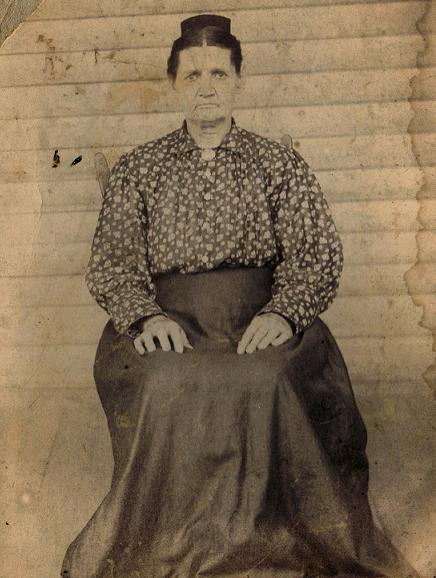
[The photo to the left of Sarah Clementine Turpin, daughter of Isaac Turpin, has been provided by Lisa Brock.]
 
Lisa reports:

First, according to a court document, Isaac Turpin owned land that adjoined Amos Thacker in 1869.  It was located on Chestnut Ridge in the 15th district of Roane County, Tennessee. The second document I have is a marriage bond for Isaac's son, William H. who married Nancy Crawford in 1877 in Roane County, Tennessee. This marriage bond was signed by William Turpin and Isaac Turpin.